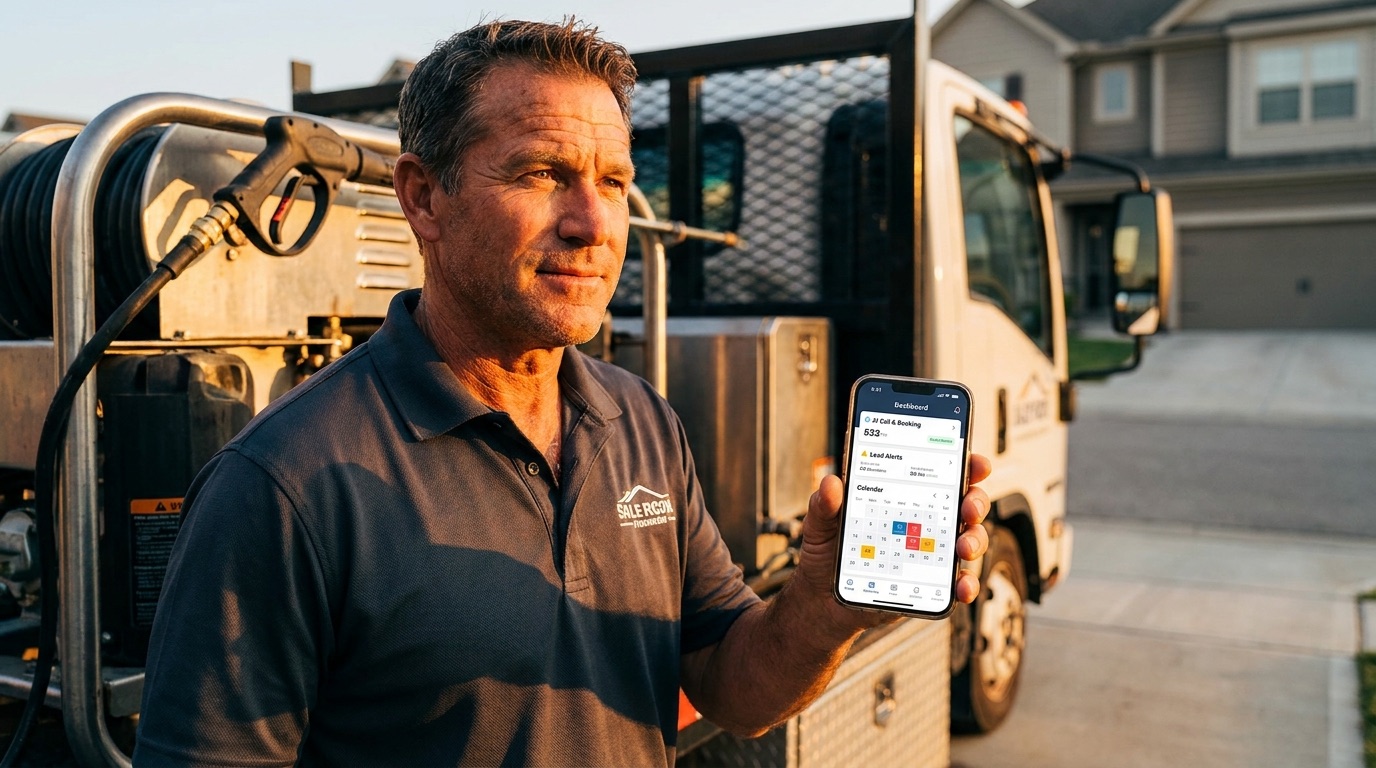
You signed up for an answering service because a running surface cleaner drowns out a ringing phone, and a missed call at 9am is a missed job by lunch. It works, sort of. Someone picks up, jots down a name and number, and texts it to you. By the time you shut down the rig, dry your hands, and call back, the homeowner has already gotten two other quotes — and one of them answered live.
That gap between "message taken" and "you actually call back with a price" is where pressure washing companies lose jobs they never even knew they were competing for. An answering service solves the missed-call problem. It does not solve the missed-quote problem, because a slip of paper with a callback request isn't the same as a priced, scheduled job.
An AI receptionist is built to close that exact gap. It doesn't just answer the phone — it asks the right questions, quotes the job on the spot, and books it while the homeowner is still on the line. This guide breaks down what each option actually does, what it costs, and when the switch from an answering service to an AI receptionist is worth it for a pressure washing business.
What a Traditional Answering Service Actually Does
A live answering service is a human operator, usually working from a shared script across dozens of client businesses, who picks up your line when the equipment is too loud to hear it ring. For a pressure washing company, that typically means:
None of this is nothing — a message beats a missed call and a full voicemail box. But every step after the message is taken is still manual. You still price the job. You still call back. You still coordinate a time by phone tag while the next lead is already calling your competitor. The answering service buys you a little time. It doesn't buy back the job.
What an AI Receptionist Does Differently
An AI receptionist is a voice agent trained on your service list, pricing rules, service area, and current calendar. Instead of taking a message and handing it off, it runs the entire front-office conversation live:
The distinction is simple: an answering service captures the call. An AI receptionist captures the call and moves the lead forward — quoted, scheduled, and confirmed — before you've done anything at all.
Side-by-Side: Answering Service vs. AI Receptionist
Here is the direct comparison pressure washing companies ask us for most, factor by factor:
| Factor | Answering Service | AI Receptionist |
|---|---|---|
| What happens on the call | Name, number, and a one-line message taken by a human operator | Full job qualification — surface, square footage, condition, timeline |
| Pricing | Not offered — you quote it yourself after the callback | Instant price range for standard jobs based on your pricing rules |
| Time to callback | Depends on when you're off the equipment and see the message | None needed — job is quoted and booked during the call |
| Calendar scheduling | Not included — you coordinate manually after the callback | Booked directly on your route and calendar in real time |
| No-show / quiet-lead follow-up | Not offered — follow-up is entirely on you | Automated SMS sequence at set intervals |
| Typical monthly cost | $150–$400/mo, usually billed per minute | $600–$2,000/mo depending on scope |
| Consistency across calls | Varies by operator and shift | Same qualification and pricing logic, every call, every time |
AI Receptionist Pricing for Pressure Washing: 3 Tiers
The AI receptionist costs more upfront than a bare-bones answering service. What you're paying for is instant quoting and scheduling, not just message-taking. Here's how the tiers break down.
Replaces a basic answering service one-for-one, plus pricing. The AI answers every call, asks about the job, and gives a price range on the spot for standard driveway, siding, and deck cleaning. No calendar booking at this tier — just a priced, ready-to-close lead.
Best for: Solo operators or small crews replacing a per-minute answering service and wanting real quoting without a full scheduling build. Setup time: 1–2 weeks.
Everything in Tier 1 plus direct calendar and route booking, CRM integration (leads write into your scheduling or field service software), quiet-lead follow-up at set intervals, and automatic weather-driven rescheduling during rainy stretches.
Best for: Companies running 2+ crews with a steady flow of quote calls during peak season. Pays for itself with one or two recovered jobs a month. Setup time: 2–3 weeks.
Custom routing across multiple crews and service territories, plus reporting on call volume, lead source, quote-to-close rate, and revenue by service type.
Best for: Multi-crew and franchise pressure washing operations where seasonal call spikes justify a custom build. Setup time: 3–5 weeks.
Case Study: Charlotte NC Pressure Washing Company, $1,200/Month, 34 Jobs Booked
Client Story
A pressure washing company in the Charlotte metro area had used a live answering service for two seasons. It worked well enough that they never questioned it — until they started tracking how many callback messages actually turned into booked jobs. The answer was fewer than half. Homeowners who left a message during a busy Saturday were often already booked with a competitor by the time the crew got back to them Monday.
Leadra.io replaced the answering service with a Tier 2 AI receptionist: 24/7 voice coverage with instant quoting, direct calendar and route booking, and a 3-touch quiet-lead follow-up sequence. Total retainer: $1,200/month. Infrastructure (voice minutes + SMS): $140/month.
In the first 30 days, the AI answered 58 calls that previously would have gone to the answering service's message queue — quoting and booking 34 directly onto the route without a single round of phone tag. By day 40, the follow-up sequence had re-engaged 8 homeowners who'd gotten a quote but gone quiet, converting 3 into booked jobs worth a combined $2,850.
Jobs booked
Same-call quoting
Quiet leads recovered
Revenue recovered
The gap wasn't call volume — the answering service was already picking up every call. The gap was everything that happened after the call ended. Every job the AI receptionist booked was priced and scheduled in the same conversation as the initial inquiry, at the exact moment the homeowner was ready to buy and hadn't yet called a competitor. See the full breakdown of how AI helps pressure washing companies get more leads.
Qualification also mattered. Of the 58 calls answered, only 34 were priced and booked as standard jobs — the rest were out-of-area requests, jobs needing an on-site look, and questions that never needed to interrupt a route slot.
5 Signs It's Time to Switch From an Answering Service to an AI Receptionist
You're losing quotes to companies that answered faster.
If homeowners mention they already booked someone else by the time you call back, the delay between message and callback is costing you jobs — not your pricing or your reviews.
Your equipment is too loud to hear the phone, and messages sit for hours.
If your answering service messages routinely go unread until the job site wraps up, the lead has usually gone cold long before you respond.
You're spending real time on phone tag to quote and schedule jobs.
Every round of "what's this going to cost" and "when can you come out" back-and-forth is time you're not spending on a driveway. Instant quoting and direct booking remove both steps.
You have no idea how many messages never turn into booked jobs.
If you can't answer "how many leads did the answering service actually convert last month," you're running blind on your most expensive marketing channel — your phone.
Your call volume spikes hard in spring and summer.
Under 15 quote calls a month, the cost gap may not be worth it yet. Above that, especially during peak season, instant quoting and booking usually pay for themselves fast.
FAQ: AI Receptionist vs. Answering Service for Pressure Washing
What's the real difference between an answering service and an AI receptionist for a pressure washing company?
An answering service takes a name, number, and a short message, then forwards it for you to call back. An AI receptionist answers the call, qualifies the job by surface type and square footage, gives a price, and books it directly on your calendar — no callback delay required.
Is an AI receptionist more expensive than a live answering service for pressure washing?
Answering services typically run $150–$400/month for basic message-taking. An AI receptionist runs $600–$2,000/month depending on scope. The higher cost buys instant quoting and scheduling instead of just a message, and most companies recover it with one or two extra jobs a month.
Can an AI receptionist actually quote a pressure washing job over the phone?
Yes, for standard jobs. It asks for square footage, surface type, and condition, then gives an instant price range based on your pricing rules. Jobs needing a closer look, like heavy oxidation or a tricky roofline, get flagged for a photo request or on-site estimate instead of a guessed price.
Should a small pressure washing business switch from an answering service to an AI receptionist?
It depends on call volume and seasonality. Under 15 quote calls a month, the cost gap may not be worth it yet. Above that, or if you're regularly losing quotes to faster-answering competitors during peak season, the AI receptionist usually closes more jobs than the extra monthly cost.
Related Reading
For Pressure Washing Companies
Stop Losing Jobs to Callback Delay
Leadra.io builds and manages AI receptionist systems for pressure washing companies. Tell us your call volume and how you're handling calls today — answering service, voicemail, or nothing — and we'll give you a tier recommendation and a realistic ROI projection based on your actual numbers.