Local SEO for Fence Installers: How to Rank in the Google Maps Pack and Win More Jobs (2026 Guide)
By Leadra.io Team · August 10, 2026 · 9 min read
Local SEO for fence installers means optimizing your Google Business Profile, review count, and local website content so your company appears in the Google Maps 3-pack when someone searches “fence company near me” or “fence installation [city].” It matters more than traditional website SEO for fence companies because homeowners overwhelmingly pick from the map pack, not the organic list below it.
Type “fence installer near me” into Google right now and look at what loads first. It is not a list of ten blue links — it is a map with three business listings, their star ratings, and a “call” button. That map pack is where fence jobs get won or lost, and most fence companies have never touched a single setting that controls whether they show up in it.
This is different from paid ads and different from your website’s blog content. Local SEO for fence installersis its own system, built almost entirely around one thing Google trusts more than anything else for “near me” searches: how established and reviewed your business looks in a specific service area. Get that right and you show up ahead of competitors who spend far more on marketing. Get it wrong and you are invisible no matter how good your crews are.
Why Fence Installers Lose the Map Pack Without Realizing It
Homeowners searching for a fence company are almost always local-intent searches — “fence company near me,” “fence installation Charlotte NC,” “privacy fence contractor [neighborhood].” Google treats these searches differently than general web searches. Instead of ranking whichever website has the best content, it ranks the three businesses it judges most relevant, established, and trusted in that specific location — and shows only those three above everything else on the page.
Most fence companies lose this fight for reasons that have nothing to do with the quality of their work:
- Their Google Business Profile was claimed once, years ago, and never touched again — no photos, no posts, no service list.
- They have 8 reviews while the map pack leader has 140.
- Their business category is set to something generic like “Contractor” instead of “Fence Contractor.”
- Their website never mentions the specific cities, towns, or neighborhoods they actually serve — just their home city.
- Their name, address, and phone number are listed slightly differently across their website, Google profile, and directory sites, which quietly erodes Google’s trust in the listing.
None of these require a bigger ad budget to fix. They require a specific, repeatable local SEO process — the same one covered in our broader LocalBusiness schema and local SEO setup guide, applied specifically to how fence companies get found.
The 3 Pillars of Local SEO for Fence Companies
Every fence company’s map pack ranking comes down to three factors Google weighs together. Strengthen all three and the ranking moves; ignore one and the other two cannot fully compensate.
1. Google Business Profile completeness and activity
This is your single most important local SEO asset, and it is free. Google rewards profiles that are fully filled out, actively updated, and specific — not just claimed and left alone. That means a correct primary category (“Fence Contractor,” not “Contractor”), a full list of services (wood privacy fencing, vinyl fencing, chain link, aluminum, ornamental, repairs), real job-site photos added regularly, and a service-area list that names every town or ZIP code you actually work in.
2. Review volume, recency, and response rate
Review count is the factor homeowners see fastest, and it is one of the strongest signals Google uses to decide which three businesses to show. A profile with 90 recent reviews at 4.8 stars will consistently outrank a competitor with 12 reviews from three years ago, even if that competitor’s website is better designed. Responding to every review — good or bad — also factors into ranking, because it signals an active, managed business.
3. Local content and citation consistency
Your website needs pages or sections that actually name the cities and neighborhoods you serve — not just your headquarters city. And your business name, address, and phone number need to match exactly across your website, Google profile, Facebook page, and directory listings like Yelp and Angi. Inconsistent listings are one of the most common, least visible reasons an otherwise solid fence company never breaks into the map pack.
| Ranking Factor | Typical Unranked Fence Company | Map Pack Fence Company |
|---|---|---|
| Google reviews | Under 15, mostly old | 80+, added weekly |
| Business category | “Contractor” (generic) | “Fence Contractor” (specific) |
| Profile photos | A few from setup, years old | Added after every job |
| Service-area coverage | Home city only | Every town actually served, listed |
| NAP consistency | Name/phone differ across sites | Identical everywhere |
Real Example: Moving From Page 3 Into the Map Pack
(This example represents the type of results our clients achieve.)
A three-crew fence installation company outside Charlotte had a Google Business Profile that had been claimed and never touched since. It sat around position 40 to 50 for “fence company near me” and never appeared in the map pack for any search in its service area. Organic and map-driven calls averaged about 8 per month, almost entirely from people who already knew the company by name.
We rebuilt the profile from the ground up — correct fence-specific category, a full service list, weekly job-site photo uploads, a structured review-request flow triggered after every completed install, and a service-area page on their website naming all eleven towns they actually served instead of just their home city.
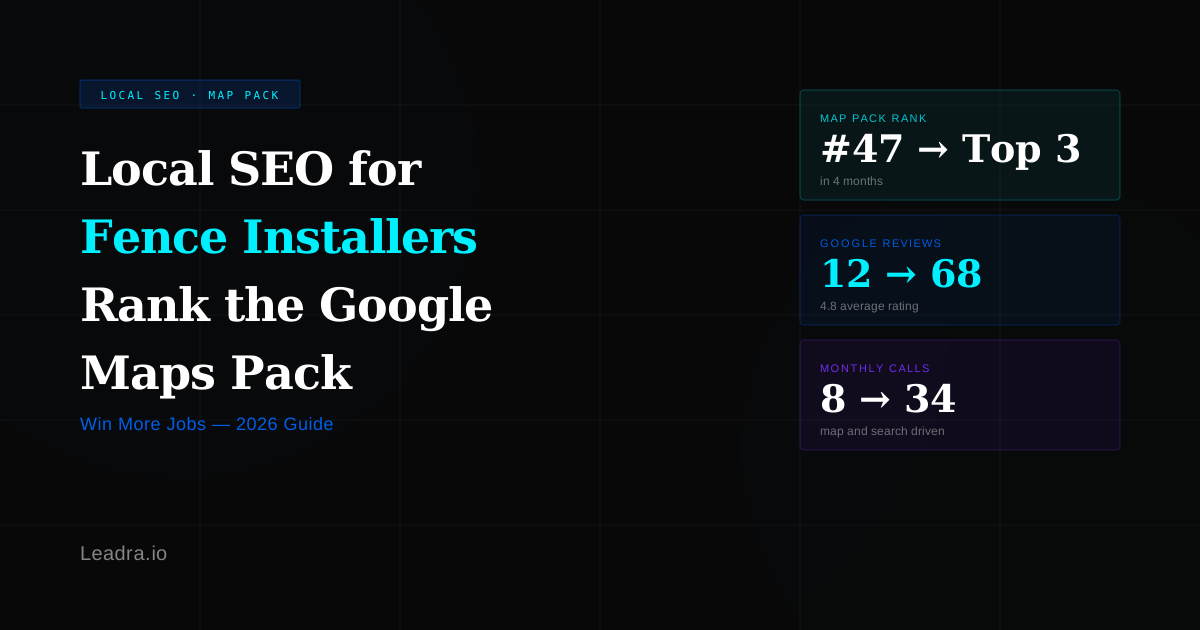
Within four months, the company’s review count went from 12 to 68, its average rating held at 4.8, and it moved into the top 3 map pack results for its two highest-volume search terms. Map-and-search-driven calls rose from roughly 8 a month to 34 a month, and the owner reported those calls converted at a noticeably higher rate than paid ad leads, because homeowners searching “near me” are typically ready to book, not just comparison shopping.
We were already the best crew in the area. Google just never knew we existed.
How to Set Up Local SEO for Your Fence Company — Step by Step
Step 1: Claim and fully optimize your Google Business Profile. Set the correct primary category, add every service you offer, write a complete business description, and list every service-area town, not just your headquarters city.
Step 2: Build a review-request system. Ask for a review from every customer right after the final walkthrough, ideally through a text or email link that goes straight to your Google review page. Consistency matters more than any single tactic here — a steady flow of new reviews outperforms an occasional push.
Step 3: Fix your NAP consistency. Check that your business name, address, and phone number match exactly across your website, Google profile, Facebook, Yelp, Angi, and any local directories. Fix mismatches — they quietly cap your ranking even when everything else is strong.
Step 4: Add local content to your website. Build out a page or section naming the specific towns and neighborhoods you serve, with real detail about the fence types and jobs common to each area, not thin duplicated text.
Step 5: Post and photograph consistently. Upload job-site photos and short Google Business Profile posts after every completed install. Profiles that stay active outrank profiles that were set up once and forgotten, even with similar review counts.
If you would rather have this built and managed for you, Leadra.io sets up the full local SEO system — profile optimization, review automation, and local content included. Call +1 (864) 721-8384 or visit our contact page to book a free strategy session.
Local SEO vs. Paid Ads for Fence Installers
Paid ads get you visibility the day you turn them on, but that visibility disappears the day you stop paying. Local SEO takes longer to build — usually two to four months to see meaningful map pack movement — but it keeps producing calls without a per-click cost once it is established. Most fence companies that grow sustainably run both: paid ads for immediate volume while local SEO builds underneath it, then lean more heavily on SEO as the map pack ranking takes hold. For the full cost breakdown across the AI marketing stack, including where local SEO fits, see our guide on AI cost for fence installer businesses.
Frequently Asked Questions
How long does local SEO take to work for a fence company?
Most fence companies see initial map pack movement within 6 to 10 weeks of a full Google Business Profile optimization, with more significant ranking gains building over 3 to 4 months as reviews and local content accumulate. It is slower than paid ads but keeps generating calls without an ongoing per-click cost.
Do I need a new website for local SEO to work?
No. Most fence companies do not need a full website rebuild — they need service-area content added to their existing site and their Google Business Profile fully optimized. A website redesign only becomes necessary if the current site is missing basic local pages entirely or loads too slowly on mobile.
How many Google reviews does a fence company need to rank in the map pack?
There is no fixed number, but competing seriously for “fence company near me” in most markets requires somewhere in the range of 50 to 100+ recent reviews at a strong average rating. What matters most is consistent new reviews arriving regularly, not just a high total that stopped growing years ago.
Can I do fence company local SEO myself, or do I need an agency?
The core steps — claiming your profile, requesting reviews, fixing listing consistency — can be done without an agency if you have the time to do them consistently every week. Most fence company owners hire this out because the ongoing consistency, not the initial setup, is what actually moves rankings, and that is hard to sustain alongside running crews and jobs.
- Homeowners searching “fence company near me” pick from the Google Maps 3-pack, not the organic list below it — and most fence companies have never optimized for it.
- Map pack ranking comes down to three factors: a fully optimized Google Business Profile, review volume and recency, and consistent local content and listing information.
- A steady, automated review-request flow after every job typically matters more than any single one-time SEO fix.
- Local SEO takes longer to build than paid ads but keeps producing calls without an ongoing per-click cost once the ranking holds.
What to Do Next
The fastest fix most fence companies can make this week is also the most overlooked: open your Google Business Profile and check whether your category, service list, and service-area towns are actually filled in correctly. Most are not. That alone will not put you in the map pack, but it removes the most common reason a fence company never gets considered in the first place.
From there, build the habit — request a review after every job, add photos after every install, and keep your business information identical everywhere it appears online. Local SEO rewards consistency more than any single big push.
At Leadra.io, we build and manage local SEO systems specifically for fence installation companies — Google Business Profile optimization, automated review requests, and local content included. Call +1 (864) 721-8384 or visit our contact pageto schedule a free 30-minute strategy call. We’ll show you exactly where your business ranks today and what it would take to get into the map pack.
Ready to show up when homeowners search?
Get a free local SEO audit from Leadra.io.
30-minute strategy call — we check your current map pack ranking, review count, and profile setup, then show you exactly what it would take to get your fence company into the top 3. No obligation.
Charlotte NC · serving fence installation companies and small businesses nationwide
Written by the Leadra.io Team. Leadra.io is an AI marketing and automation agency helping fence installers, dental practices, and small businesses grow with AI-powered systems. Based in Charlotte, NC — serving clients nationwide.